Why is Made in America Valuable to Manufacturing?
In the last few years, “Made in America” has evolved from a nostalgic slogan into a strategic movement for U.S. manufacturing. Deloitte‘s Center for Government Insights called it a new “American manufacturing renaissance. With a focus on bolstering domestic manufacturing, the United States has an opportunity to advance its global standing and enhance Americans’ flourishing through job growth, greater industrial resiliency, and innovation.”
For American manufacturers, this shift isn’t just about patriotism—it’s about supply chain resilience, brand trust, market differentiation, and financial opportunity. At Mobilization Funding, we believe deeply in backing American-made businesses because we know they are engines for stable jobs, local prosperity, and stronger supply chains. We are here to serve and support U.S. manufacturers as they overcome challenges and help prepare them for future growth.

How to keep American Manufacturing American Made
Here are some ways you can help overcome recent challenges and ensure your company remains Made in America.
1. Supply Chain Pressure & Reshoring
A plethora of unforeseen “obstacles” have been placed on manufacturers over the last five years. The COVID pandemic, geopolitical conflicts, trade tensions, and global shipping fragility all exposed the risks of overdependence on far-flung supply chains. Many firms are now “reshoring” or bringing production back to the U.S. to reduce risk and increase responsiveness. While these changes greatly affect businesses, there is also so much room for opportunity. Manufacturers who commit to staying American Made can strengthen customer loyalty, improve quality control, shorten lead times, and differentiate themselves in crowded markets. Domestic production also opens access to government and infrastructure contracts that prioritize U.S. based suppliers.
Additionally, localizing operations gives manufacturers the advantage of tighter supplier relationships, better collaboration, and faster problem-solving—key drivers of long-term competitiveness. With advancements in automation, digital manufacturing, and workforce training programs, American factories are also becoming more efficient and adaptable than ever before.
Why the Supplier relationship is Key to American Manufacturing
In this article, “What’s Coming for US Manufacturing in 2025”, the study suggests that “Supplier relationship management will be key. Businesses should move beyond transactional relationships and focus on developing strong relationships with ongoing communications and increased transparency. This will help manufacturers react more quickly to market demands or disruptions.” They go on to say how important it is to strengthen relationships with local suppliers, and connect, learn, and partner with larger manufacturers who are also reshoring.
“When American manufacturers bring production home, they strengthen more than their own businesses—they strengthen the entire backbone of our country. Reshoring isn’t just a strategy; it’s a commitment to resilience, speed, and self-reliance.”- Scott Peper, Mobilization Funding CEO
2. Consumer Research
Over the years, Americans have grown more aware of where their products and materials are made. Whether it is for quality, speed, risk mitigation, political opinion, or patriotism, the vast majority of consumers now prefer—or even require—American Made. The “Made in America” label often carries intrinsic trust and perceived value. That said, consumer willingness to pay premiums can fluctuate. A 2025 poll conducted by IT firm Integris stated that, “75 percent of U.S. consumers have a preference for U.S.-made goods, a rate that has been boosted thanks to the temporary disruptions in supply chains during the COVID-19 pandemic. However, 62 percent said that other factors, including quality and price, are more important in dictating their purchasing decisions.”
What can Manufacturers do with this Information?
This article brings up a very interesting point, and proves there appears to be a mismatch in perception vs. reality amongst consumers here.
- Consumers like the idea of “Made in USA,” but when push comes to shove, especially on price, many prioritize more affordable or higher-quality alternatives.
- For manufacturers, that means origin alone isn’t enough to justify a high markup. Other factors like quality, performance, and value need to be part of the story.
Overall, this highlights the fact that consumers need more education on this topic in general! Businesses (and marketers) of consumer packaged goods, and manufacturers need to inform their customers, not just about where a product is made, but why: the broader economic, social, and long-term value of buying American. Many Americans love the idea of “Made in USA,” but don’t fully grasp the trade-offs involved in economics, labor, and infrastructure that make U.S. made goods more expensive to produce. We need to lift up that story — why higher costs might reflect better working conditions, higher craftsmanship, and national economic strength.
From our side as a funder, we see the importance of supporting manufacturers who are producing in America. These businesses often face higher upfront costs for labor, equipment, and materials. That’s why we design flexible financing programs that align with their cash-flow cycles. When manufacturers succeed, they can offer competitive, Made-in-America products without collapsing under financial pressure.
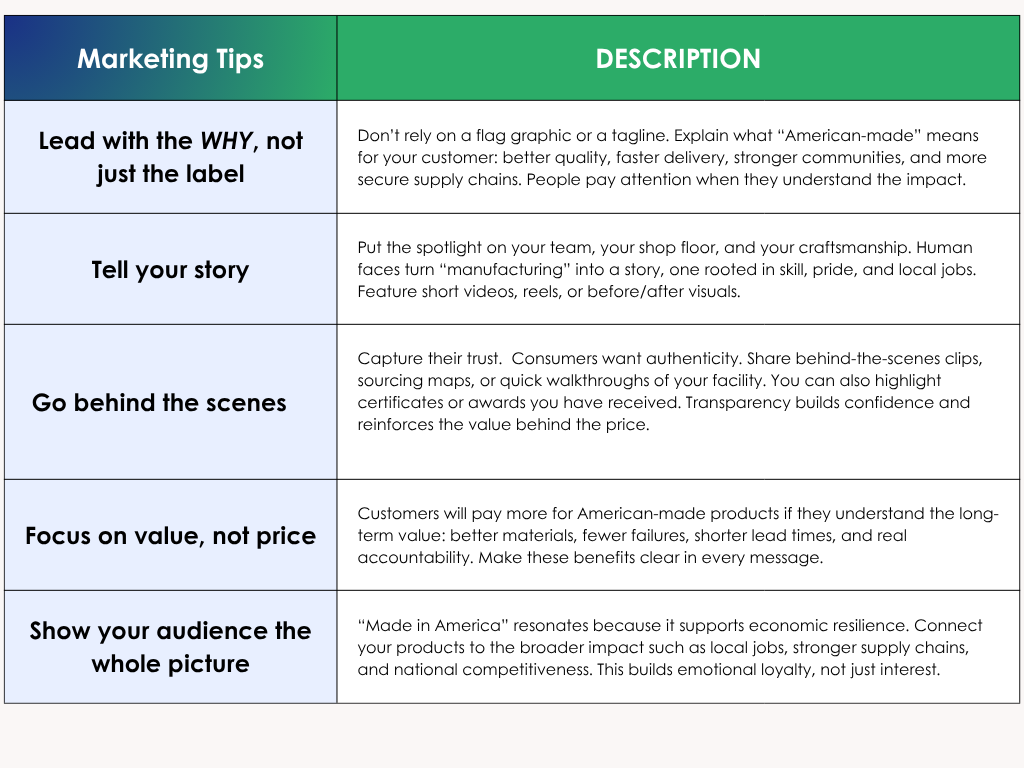
5 Marketing Tips to Highlight Your “Made in America” Story
3. Technological Enablement
Technology advancements play a continued role in the survivorship of manufacturing. “Automation, robotics, additive manufacturing (3D printing), AI-driven process control, and digital manufacturing tools are lowering the labor cost burden and making “smarter” U.S. manufacturing more competitive.”-IT Firm: Integris
American based factories can serve as agile hubs for custom orders, quick-turn prototypes, and just-in-time supply. This will require that emphasis on relationship building and scouting out those new supply chains!
4. Talent, Opportunity & Workforce Revival
Jobs in manufacturing had long been perceived in the U.S. as declining or stagnant. Many of the millennials are not typically searching for jobs in manufacturing or construction. But today’s factories—driven by tech, automation, and skilled trades—offer compelling, resilient careers. This is especially true when viewed alongside construction trades and infrastructure work, which also play a key role in the revival of American industry.
In fact, that point is powerfully captured in Mobilization Funding CEO, Scott Peper’s, TEDx talk.
“Manufacturing and construction are still some of the greatest pathways to the American Dream. These careers restore dignity, create stability, and give people a chance to build a life they’re proud of—and America needs a lot more of that.”- Scott Peper
He discusses construction and manufacturing trades as vibrant pathways to the American Dream, restoring dignity, stability, and purpose in career choices.
How U.S. Manufacturers Can Capitalize on the Made in America Trend
If you are a manufacturer or business in consumer packaged goods, here are 3 strategic tips you can pull to benefit from this momentum:
Clarify Your “Made in America” Story
- Ensure your sourcing and production actually meet relevant regulatory or FTC standards for “Made in USA” or comparable labels. Misleading claims can backfire.
- Use your origin story in branding, marketing, and sales. Be transparent about cost trade-offs, quality gains, and supply-chain security.
- Tailor messaging by vertical: government, defense, infrastructure, OEMs, or consumer goods all may respond differently to “American made.”
Target Verticals with Buy-American or Domestic Preference Rules
Many public contracts, infrastructure projects, and defense or transportation procurements prioritize domestic supply. Manufacturing locally allows you to bid more competitively or meet set-aside requirements.
Optimize Your Capital & Cash Flow Strategy
Producing domestically often requires upfront investment: new equipment, training, facility upgrades, or scale adjustments. That’s where project financing, purchase order financing, contract financing, and smart cash flow management play a critical role.
You’ll want to:
- Build a clear capital plan: phased equipment rollout, lease vs buy, ROI timing.
- Use a Cash Flow Tool to help manage cash flow and understand your margins
- Use a Cash Flow Tool to help manage cash flow and understand your margins
- Maintain working capital buffers to absorb short-term cost fluctuations.
- Leverage contracts or POs as collateral or triggers for funding and finance support
- Structure your capital stack so growth capital (equity or mezzanine) and debt don’t overly burden operations.
“Strong cash flow is what gives manufacturers the confidence to take on bigger contracts, hire more people, and invest in growth. When the financing matches the rhythm of the work, American businesses win—and so do American communities.”- Scott Peper
Utilize Lean, Agile, & Smart Manufacturing
- “Use predictive maintenance, digital twins, IoT sensors, and AI to drive uptime and reduce waste.”
- Embrace modular or flexible manufacturing lines so you can pivot between product types or volumes.
- Reduce inventory risk through on-demand or “just in time” approaches.
- Partner with local suppliers and co-manufacturers to create regional ecosystems and reduce logistic drag.
Workforce Development & Culture
- Invest in training, apprenticeships, cross-skilling, and partnerships with technical colleges or trade schools.
- Highlight career pathways (not just jobs). Emphasize that today’s manufacturing roles are high-tech, high-skill, and high-possibility.
- Use recruitment messaging around stability, community impact, and being part of the American revival.
Made in America is more than a Label
The “Made in America” movement is more than a label; it’s a confluence of market, policy, technology, and social dynamics. Manufacturers who align with it thoughtfully—by building credibility, managing capital rigorously, and producing smartly—can ride a tailwind of demand, differentiation, and opportunity.
At Mobilization Funding, we believe deeply in backing American-made businesses because we know they are engines for stable jobs, local prosperity, and stronger supply chains. We are here to serve and support U.S. manufacturers as they overcome challenges and help prepare them for future growth. If you’re a manufacturer or contractor considering greater domestic production, check out our Resources & Insights page for deeper guides, case studies, and tools.
Together, we can help renew American manufacturing strength, from the shop floor to the financing stack.