


Key Findings
90% of senior decision-makers say they have passed on a profitable construction project because of cash flow timing, including 43% who say they have done so multiple times.
100% say cash flow influences whether their company pursues or declines a construction project, including 57% who say it always or frequently acts as a gating factor.
97% say the challenge of funding upfront project costs while trying to grow has kept them up at night, including 76% who say it keeps them up always or frequently.
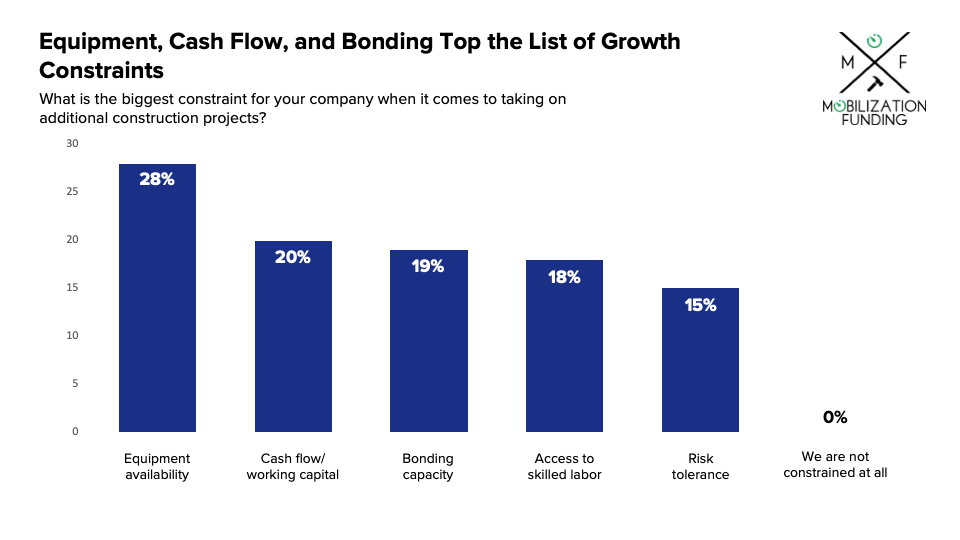
The top constraint on taking on additional projects is equipment availability (28%), followed by cash flow or working capital (20%) and bonding capacity (19%).
If capital were immediately available, 42% say it would increase speed of execution, 41% say it would reduce financial stress, and 40% say it would improve vendor relationships.
“Construction companies do not have a demand problem as much as they have a timing problem,” said Scott Peper, CEO at Mobilization Funding. “Firms are finding work and seeing opportunities, but too many are being forced to slow down, stretch internal resources, or walk away from good projects because capital is not arriving when the work demands it. That gap between opportunity and access is where growth stalls.”
Growth Is Happening, but It Comes With Pressure
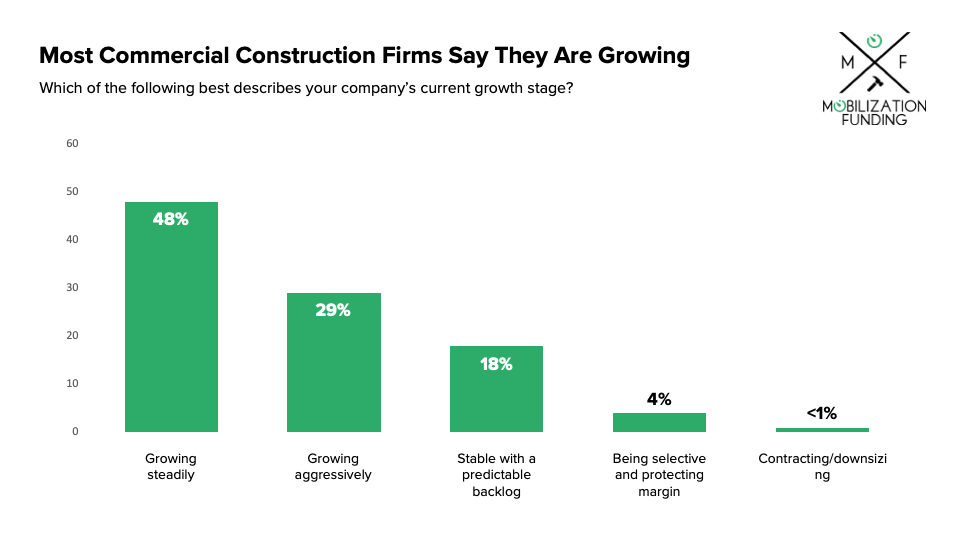
Commercial construction firms are not standing still. More than three-quarters (78%) of respondents describe their companies as growing today, including 48% who say they are growing steadily and 29% who say they are growing aggressively. Another 18% say they are stable with a predictable backlog, leaving only 5% in a more defensive posture.
Opportunity is there, but taking it on cleanly is challenging. Growth increases pressure on labor, equipment, working capital, and the balance sheet.
Looking ahead 12 to 24 months, respondents point to bigger projects as the top strategic priority at 20%. Strengthening the balance sheet follows at 19%. After that, priorities spread across maintaining current size (16%), entering new geographies (16%), accelerating growth (15%), and improving profitability (14%).
The industry is still pushing forward, but doing so carefully. Companies want growth, but they also want more control over the strain that comes with it.
Capacity Constraints Go Beyond Labor
When leaders were asked about the biggest constraint on taking on additional projects, equipment availability ranked first at 28%. Cash flow or working capital came next at 20%, followed by bonding capacity at 19% and access to skilled labor at 18%. Risk tolerance followed at 15%.
Equipment tops the list, with cash flow right behind it. Firms are weighing whether they have the equipment, liquidity, and bonding support needed to take on more work with confidence.
That pressure gets sharper as firms look toward larger projects. Bigger opportunities often require stronger support at the front end. The work may be available, but the question is whether the business can carry the early burden that comes with it.
Winning Work Can Trigger the Funding Squeeze
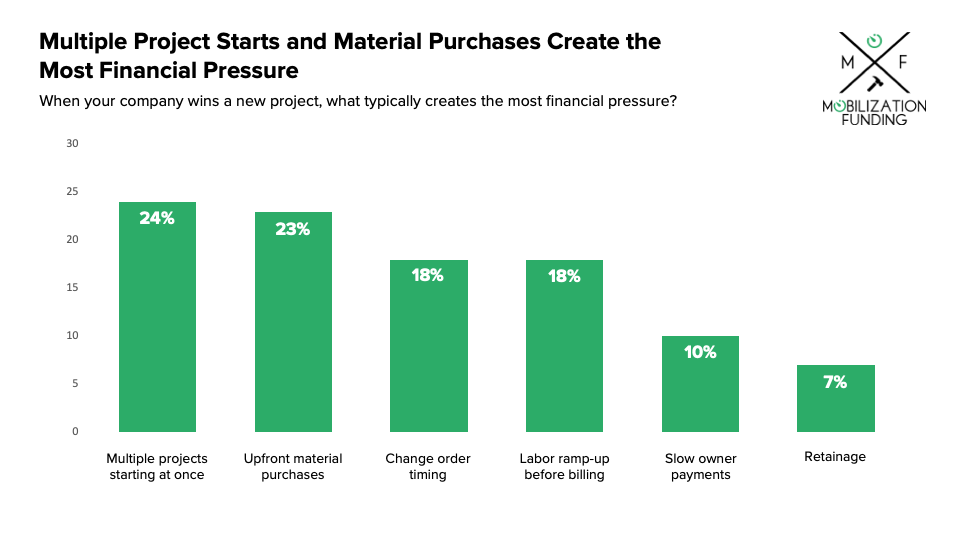
For many firms, the pressure spikes as soon as a project is awarded. When asked what creates the most financial pressure on a newly awarded job, 24% pointed to multiple projects starting at once and 23% cited upfront material purchases. Change order timing came in at 18%, with labor ramp-up before billing also at 18%. Slow owner payments followed at 10%, and retainage at 7%.
New work may promise future income, but it often requires immediate outlay. Several starts in the same window can stack material orders, payroll, and scheduling costs before meaningful revenue arrives. For firms without much room on the balance sheet, growth can create pressure almost as soon as it creates opportunity.
Funding Pressure Is Taking a Personal Toll
The strain does not end with project logistics. Nearly all respondents say the challenge of funding upfront project costs while trying to grow keeps them up at night. More than half (54%) say it does so frequently, and another 22% say always. Only 2% say rarely and less than 1% say never.
That pressure carries into day-to-day decision-making. It reflects the challenge of keeping work on track, covering early costs, and moving ahead without full confidence in when cash will arrive.

Cash Flow Timing Shapes Which Projects Get Done
Cash flow influences project decisions across the board. All respondents say it affects whether they pursue or decline a project. More specifically, 10% say it always influences the decision and 47% say it frequently acts as a major gating factor. Another 39% say it sometimes influences the call depending on project size, while 4% say it matters but only rarely.
The business consequence is even more direct. 90% of respondents say they have passed on a profitable construction project because of cash flow timing at their current company. Of that group, 48% say they have done so once and 43% say they have done so multiple times. Another 8% say they have not done so yet, but have come close.

Firms Are Using a Patchwork of Funding Sources
Asked how they currently and mainly fund upfront project costs, respondents spread their answers across a wide range of sources. Owner deposits or front-loaded billing lead at 22%, followed by bank lines of credit at 18% and internal cash reserves at 16%. Supplier credit, limiting growth to avoid capital strain, and partner financing each come in at 15%.
There is no single dominant method firms rely on to carry early project costs. Many are piecing together a capital strategy from whatever options are available. Some lean on customers. Some draw on their own reserves. Some turn to vendors or financing partners. Some pull back on expansion to protect the business from overextension.
Leaders also point to several types of partners that would create value. The top choice is an equity or growth capital partner at 20%, followed by surety and bonding support at 18% and equipment finance or leasing at 17%. Strategic or advisory capital support stands at 16%. Project-based capital partners and ongoing working capital partners each draw 14%.
Immediate Capital Would Change More Than Stress Levels
When leaders were asked what immediate access to capital would do for their business, the answers pointed to a much broader operational effect. The top response was increased speed of execution at 42%, followed closely by reduced financial stress at 41% and improved vendor relationships at 40%. Many also said it would enable the pursuit of larger contracts (39%) and allow them to take on more projects (38%).
Access to capital creates room to operate. It helps firms mobilize faster, support vendors, and pursue larger jobs without putting the rest of the business under strain.
Conclusion
Commercial construction firms continue to chase growth, but cash flow timing is shaping how far and how fast they can go. The gap between when costs hit and when payments arrive affects project decisions, slows expansion, and leaves some profitable opportunities out of reach.
For firms looking to take on larger opportunities, access to capital is becoming part of what it means to be ready. It supports execution, strengthens vendor relationships, and gives companies greater confidence as new work comes in.
“Mobilization Funding was founded to help construction contractors and subcontractors grow their businesses with fewer roadblocks through contract-based financing,” said Peper. “In the process, we’re helping our clients to sleep better at night, and to achieve their goal to grow.”
For many firms, the next phase of growth will depend on how well they can bridge the gap between winning work and funding it.
Methodology
Mobilization Funding commissioned Censuswide to conduct a survey of 250 senior decision-makers at U.S. commercial construction companies, including contractors and subcontractors with $5 million to $50 million in annual revenue.
The survey was conducted between February 10 and February 17, 2026. Respondents were aged 30 and older and represented companies across multiple regions and business sizes within the commercial construction industry.
Censuswide is a member of the Market Research Society (MRS) and complies with the ESOMAR principles and the British Polling Council’s code of conduct.