


Most Americans Blame Bad Planning for Construction Delays. Contractors Say the Real Damage Comes From Late Payments.
New survey reveals the hidden role of cash flow in the traffic jams and stalled projects Americans love to hate.
From detoured commutes to half-finished roads, construction delays are a daily frustration. Ninety-one percent of Americans say they’ve had to change routes or plans because of construction, and seven in 10 say those delays affect their daily life. Most point the finger at mismanagement or bad weather.
But new data shows the story is more complicated. Weather is the most common cause of delays, but when projects stretch on for weeks, it’s often because of something the public never sees: payment delays and cash-flow problems.
Mobilization Funding’s 2025 Construction Delays and Payment Timing Report draws on two nationwide surveys the company conducted via Pollfish in August 2025. The first survey asked 600 U.S. adults about their experiences with and beliefs about construction delays. The second survey probed the topic with 400 U.S. construction professionals who make final project decisions or have significant input on budgeting, scheduling, or vendor selection.
The findings expose a sharp divide between what the public believes causes delays and what professionals actually experience on the ground.
“When people see orange cones and traffic backups with no crew in sight, they assume the problem is bad planning or weather,” said Scott Peper, CEO of Mobilization Funding. “But more often than the public realizes, the problem is subcontractors waiting on checks.”
Key Findings
- For the public, disruption is routine. Ninety-one percent of U.S. adults have changed routes or plans because of construction, and 70% say delays affect daily life (53% “somewhat,” 17% “significantly”).
- Weather is the most frequent disruptor. Forty-three percent of construction professionals named unpredictable weather as a major cause of delays, ahead of material shortages (35%), client-side holdups (31%), and permitting (29%).
- Payment delays are less frequent but more damaging when they happen. One in four pros (25%) listed late payments as a major cause of delays. These delays can be far more significant than one caused by a rainy day. Pros said 76% of projects hit by late payments lose at least a week, with 38% saying late payments typically add more than three weeks to their timelines.
- The perception gap is stark. The public blames mismanagement (63%) and weather (56%) for construction delays; only 19% attribute them to delayed contractor payments. Two-thirds (67%) admit they are not or only minimally familiar with how payment timing affects schedules.
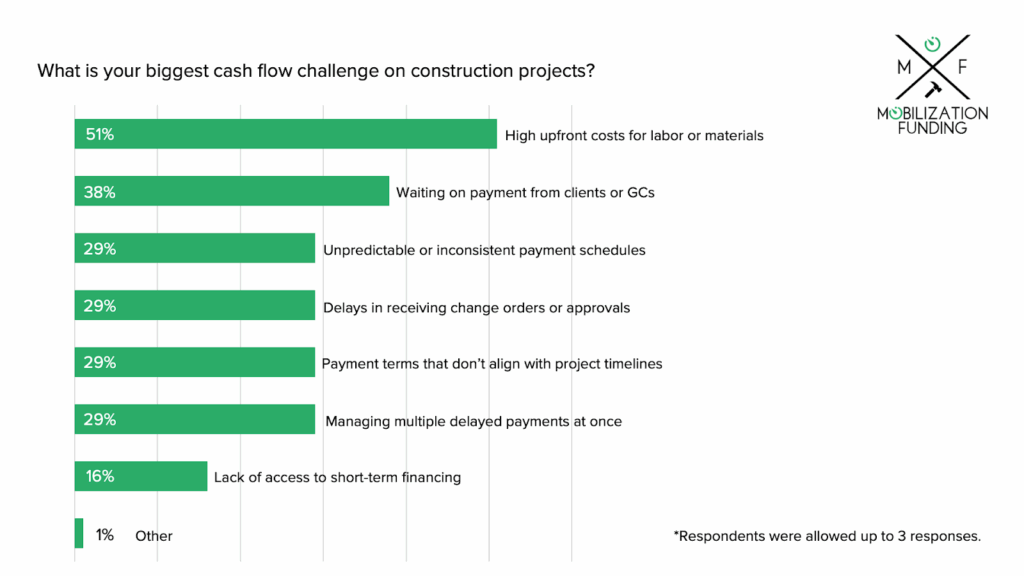
- Cash-flow strain limits growth. Among subcontractors and other construction professionals, the biggest payment challenges creating delays are high up-front costs (51%) and waiting on payment (38%). More than half (56%) say they’ve had to turn down projects due to cash-flow or payment risks.

What Pros Experience on the Ground
“Crews are expected to be at a job site for a predetermined amount of time, including an allotment for delays. If that time is delayed further, it can infringe upon the next planned project.” — Construction Professional Survey Respondent
On job sites, unpredictability usually starts with weather. But money issues do the most damage when they strike.
Nearly half of pros (47%) say late payments add one to two weeks to a project, and almost 30% say they add three to six weeks. Only 15% say they don’t extend timelines. The result: weeks of slippage that the public assumes come from poor planning.
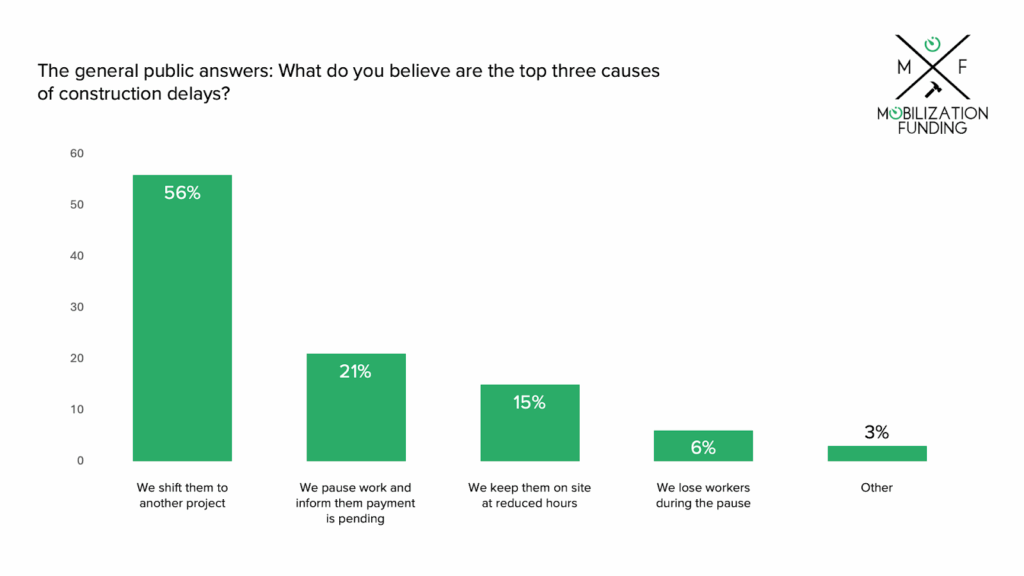
Contractors can’t afford idle crews. When payments are late, 56% shift workers to other projects, 21% pause work until payment clears, 15% keep crews on reduced hours, and 6% lose workers entirely.
Asked what would help keep schedules intact, pros gave pragmatic answers: better planning by the contractor (26%), access to up-front working capital (22%), and faster client payments (21%).
Public Perception vs. Reality
“We have a highway that is being built that is redirecting a lot of traffic away from my business.” — Public Audience Survey Respondent
“One road in my area has been closed because of a bridge for 6 years!!” — Public Audience Survey Respondent
The public sees delays everywhere — and they blame the most visible actors.
For public projects, nearly half (49%) say contractors are most responsible for delays, compared to 32% who blame local government and 18% who blame the state. For private projects, the perception is even starker: 71% blame contractors, while just 28% blame developers.
In general, confidence in efficiency is low among the public: just 7% are “very confident” projects are well managed, with 42% saying they were “somewhat confident.” More than half said they are “not very” or “not at all” confident.
When asked about causes, 63% pointed to mismanagement/poor planning and 56% to bad weather, while only 19% mentioned delayed payments
“I wish people knew that delay in funding or permits can push back the entire project timeline.” – Construction Professional Survey Respondent
The Cost of Delays
Delays carry both social and financial costs.
- Public trust: 73% of Americans say delays reduce their trust in construction projects (32% “yes,” 41% “sometimes”).
- Business strain: The biggest cash-flow challenges are high upfront costs (51%) and waiting on payments (38%), followed by slow approvals or misaligned terms (29% each).
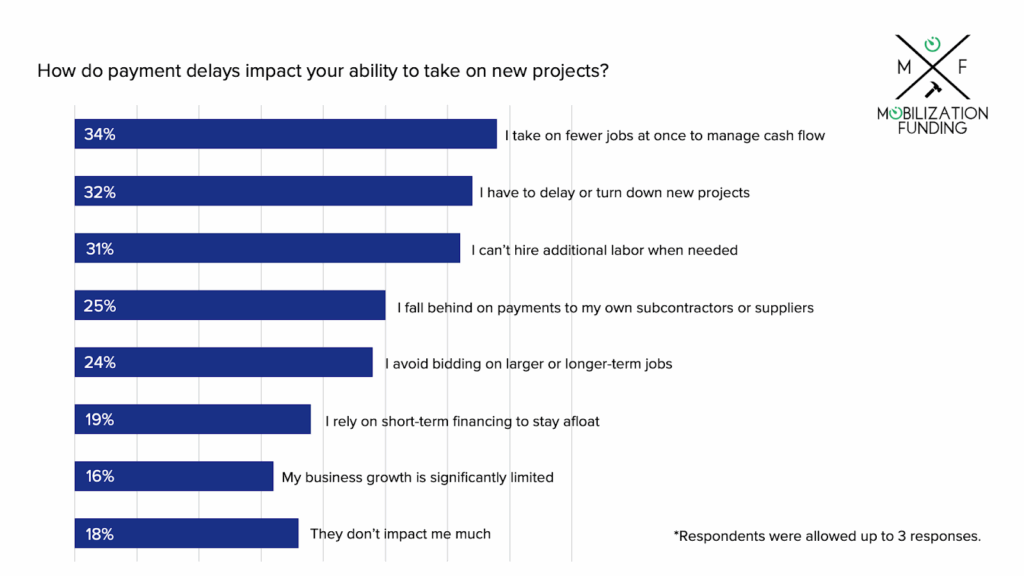
- Lost opportunities: 34% of pros take on fewer jobs to manage cash flow, 32% turn down projects, and 31% avoid hiring additional labor.
- Hard choices: More than half (56%) have walked away from projects due to cash-flow or payment risks.
- Small subcontractors hit hardest: 66% of pros said small construction businesses face more financial delays than large firms.
That alignment shows a clear risk: when smaller subcontractors are squeezed by late payments, they scale back crews, reduce hours, or pull off jobs entirely. And when subs stop, whole projects stall.
Recommended Practices
For most construction projects, subcontractors are the linchpin of keeping projects on time, but they’re also the most exposed to cash-flow strain. Owners and general contractors can ease pressure, but subcontractors also need financial tools to stay moving.
- Secure mobilization capital for subs. Subcontractors face high upfront costs before they get paid, so securing funding in advance is critical.
- Set and publish a payment calendar. Owners and general contractors should lock in release dates. When subcontractors know when money is coming — and have financing to bridge gaps — schedules stay steady.
- Offer accelerated pay paths. Quick-pay programs or opt-in accelerated terms give subcontractors faster access to funds, especially when paired with outside financing.
- Make payment status visible. Distinguish between weather delays and payment delays so subcontractors can plan crews effectively. Transparency, combined with working capital, keeps work flowing.
Conclusion
From the street, the story of delays looks simple: cones, crews, and traffic. On site, it’s more complex: weather, approvals, materials, and money. Weather sets the boundaries, but cash flow often decides whether projects stay on track or slip behind.
When payments move on time, projects stay staffed, schedules hold, and the public sees progress instead of detours. When they don’t, weeks are lost, trust erodes, and subcontractors shoulder the risk.
“On-time delivery is set up for success during the preconstruction phase,” said Peper. “Not just the drawings and work schedule, but the cash flow of the project overall. When the money runs with the work, subcontractors don’t carry the float and contractors can deliver at full speed.”